-
+86-13791972057
-
No. 3009, Tower 3, Zhuoyue Century Center, No. 31th Longcheng Road, Qingdao, Shandong, China


+86-13791972057
No. 3009, Tower 3, Zhuoyue Century Center, No. 31th Longcheng Road, Qingdao, Shandong, China








2026-10-23
One of the most common questions we get is: "How big of a unit do I actually need?"
And it's a great question—because getting this wrong is expensive. Too small, and you're constantly running at max capacity, wearing things out early. Too big, and you've just spent a fortune on capacity you'll never use.
Here's how to think about it.
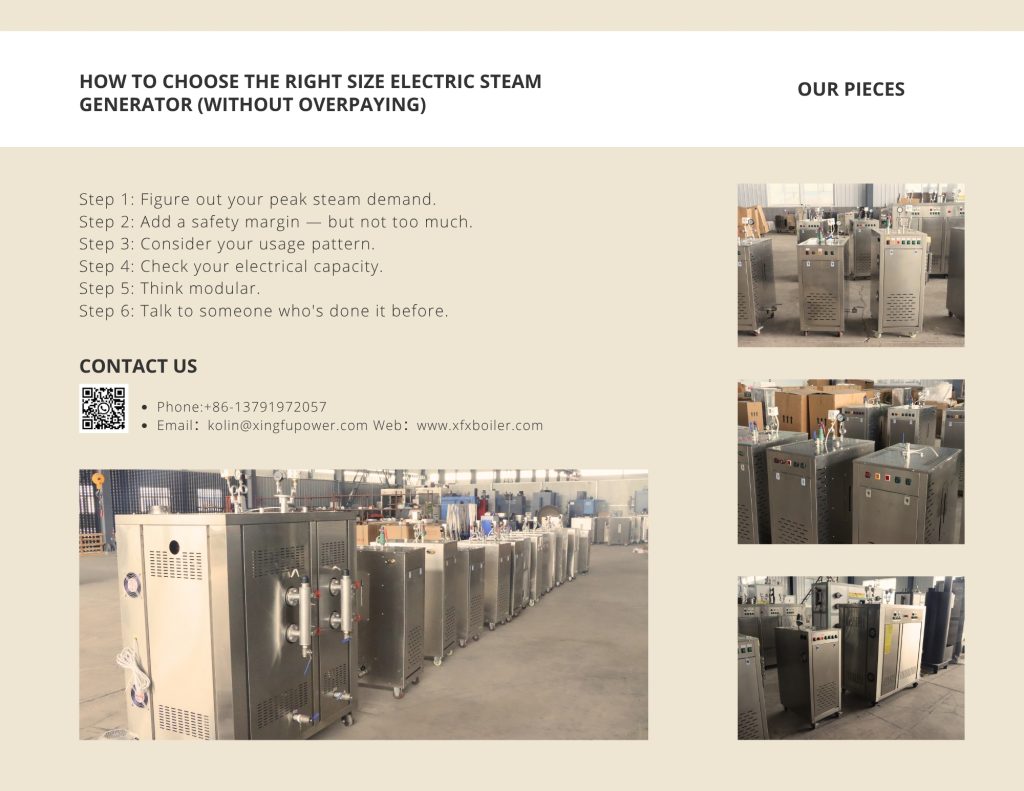
Step 1: Figure out your peak steam demand.
Not average. Peak. What's the maximum amount of steam you need at any given moment? Measure in kg/h or lbs/h. Look at your current boiler's rated output and how hard it's actually working during your busiest shifts.
Step 2: Add a safety margin—but not too much.
A 10%—20% buffer is smart. It covers unexpected demand spikes and gives you room to grow. A 100% buffer? That's just burning money.
Step 3: Consider your usage pattern.
Do you need steam 24/7, or just for a few hours a day? If it's intermittent, a smaller unit that starts fast and shuts down cleanly is ideal. If it's continuous, you might want multiple smaller units running in parallel—better redundancy, better part-load efficiency.
Step 4: Check your electrical capacity.
This is the constraint most people forget. A 500 kW electric steam generator needs a serious electrical supply. Before you fall in love with a spec sheet, talk to your electrician about what your panel can actually handle.
Step 5: Think modular.
Here's a pro tip: instead of one giant unit, consider multiple smaller units. Why?
Step 6: Talk to someone who's done it before.
Every facility is different. Water quality, altitude, ambient temperature, piping layout—all of it affects sizing. A good vendor will ask you the right questions and help you get it right the first time.
We do this every day. If you're not sure what size you need, just reach out—we'll walk you through it, no obligation.
👇 What's your current steam capacity, and what's your biggest sizing headache? Let's figure it out together.
Okay, let's talk about something unsexy but critically important: water quality.
Here's the deal. Electric steam generators are tough, reliable machines. But they have one weakness: scale buildup.
If you're using hard water with high mineral content, those minerals don't just disappear when the water turns to steam. They stay behind, coating the heating elements with a layer of crusty deposits.
What happens next?
And here's the frustrating part: this is 100% preventable.
How to protect your investment:
Option 1: Water softener
The simplest solution. A standard water softener removes calcium and magnesium before the water enters the generator. Cheap, effective, low maintenance. If your water hardness is above 100 mg/L, you probably need one.
Option 2: Reverse osmosis (RO)
For high-purity applications — pharma, food, labs — RO removes almost everything. It's more expensive upfront, but the water quality is exceptional, and your generator will love you for it.
Option 3: Deionization (DI)
Similar to RO, but uses resin beads to remove ions. Great for small-scale, high-purity needs. Requires more frequent media replacement.
Option 4: Regular descaling
Even with treatment, some scale will eventually form. A periodic descaling routine — every 3-6 months, depending on water quality — keeps things running smooth. It's a simple process, and most units have built-in access ports for easy cleaning.
The bottom line: water treatment isn't glamorous, but it's the single best thing you can do to extend the life of your electric steam generator. Skip it, and you'll pay for it later.
👇 What's your water hardness like? Ever had a scale problem? Share your experience below.