-
+86-13791972057
-
No. 3009, Tower 3, Zhuoyue Century Center, No. 31th Longcheng Road, Qingdao, Shandong, China


+86-13791972057
No. 3009, Tower 3, Zhuoyue Century Center, No. 31th Longcheng Road, Qingdao, Shandong, China








2026-10-16
Electric steam generators aren't a one-trick pony. They work across industries—but how they're used varies a lot.
Let me break down what we see in the field.
🍽️ Food & Beverage
Steam is used for cooking, sterilization, cleaning, and even direct injection into some products. The big requirements here are purity and consistency. Electric steam delivers both—no combustion byproducts, no risk of contamination. Plus, the fast startup means you can fire up for a production run and shut down after, instead of keeping a boiler idling all day.
💊 Pharmaceutical & Biotech
Clean steam is non-negotiable. Any trace of combustion residue can ruin a batch worth millions. Electric units are ideal because the steam is generated with zero contact with fuel or exhaust. Many pharma companies are now specifying electric steam in their cleanroom designs.
🏥 Healthcare & Hospitals
Autoclaves. Sterilization. Laundry. HVAC humidification. Hospitals need steam 24/7, and they need it reliable. Electric units are quiet, clean, and can be placed close to the point of use—reducing piping losses and improving response time.
👕 Textile & Apparel
Dyeing, finishing, pressing, and fabric setting all require precise temperature and pressure control. Electric steam gives you that precision. And because there's no flue, you can install units right on the production floor—no need for a separate boiler room.
🛢️ Oil & Gas
Heavy oil recovery relies on steam injection. Electric downhole steam generators are now being deployed to make this process greener and more efficient. Instead of generating steam at the surface and losing heat through long pipelines, the steam is generated right where it's needed — downhole.
🔧 Small Manufacturing & Workshops
Parts cleaning, curing, forming, and humidity control. These businesses often don't have a boiler room or a dedicated operator. Electric units are compact, plug-and-play, and fully automatic—perfect for operations without a maintenance team.
🏢 Commercial Buildings
Humidification, heating, and sterilization. Electric steam is clean, quiet, and easy to integrate into building management systems.
The common thread? Every industry has different needs, but they all benefit from the same core advantages: clean steam, fast response, low maintenance, and zero emissions.
Let's zoom out for a second.
Ten years ago, electric steam was a niche solution. Expensive. Limited capacity. Mostly used in labs and small operations.
Today? It's one of the fastest-growing segments in industrial heating.
Here's why.
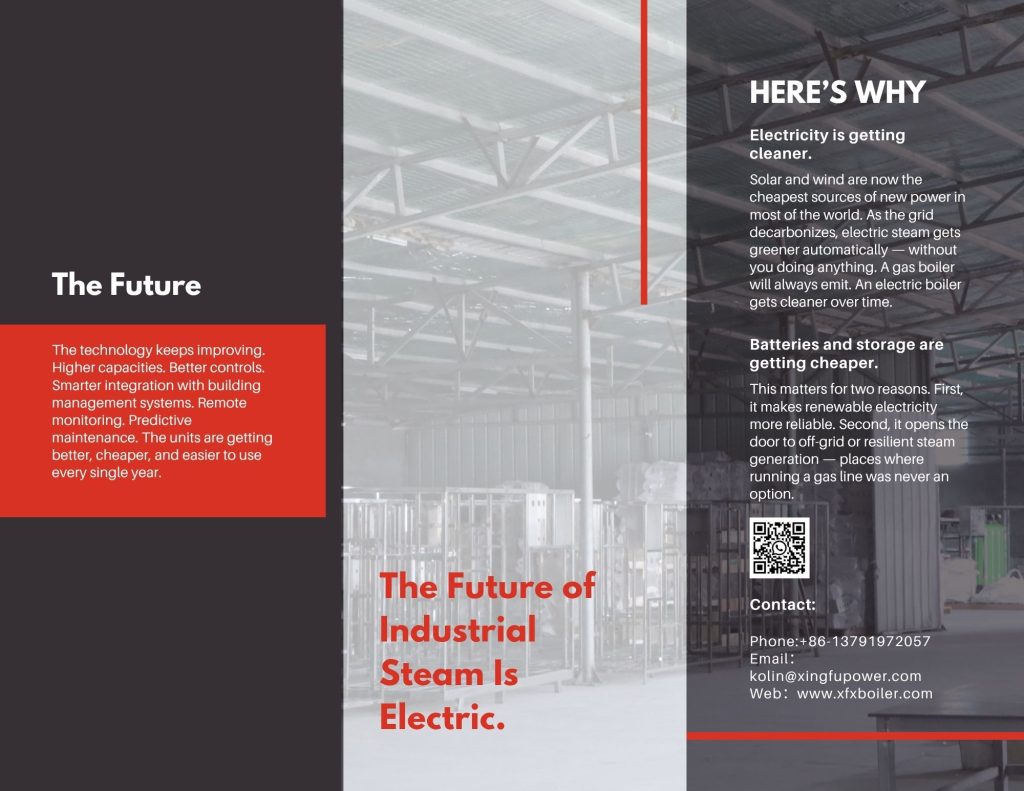
Electricity is getting cleaner.
Solar and wind are now the cheapest sources of new power in most of the world. As the grid decarbonizes, electric steam gets greener automatically—without you doing anything. A gas boiler will always emit. An electric boiler gets cleaner over time.
Batteries and storage are getting cheaper.
This matters for two reasons. First, it makes renewable electricity more reliable. Second, it opens the door to off-grid or resilient steam generation — places where running a gas line was never an option.
Regulations are tightening.
Carbon taxes. Emissions caps. Fuel bans in urban areas. Every year, the rules get stricter for fossil fuel equipment. Electric steam is already compliant with regulations that haven't even been written yet.
The technology keeps improving.
Higher capacities. Better controls. Smarter integration with building management systems. Remote monitoring. Predictive maintenance. The units are getting better, cheaper, and easier to use every single year.
The economics keep getting better.
As renewable electricity gets cheaper and carbon taxes push fossil fuel costs up, the business case for electric steam only strengthens. What might not have penciled out five years ago often does today.
So here's my honest take:
If you're planning any kind of equipment upgrade in the next 1-3 years, electric should be on your shortlist. Not because it's trendy. Because it's practical, it's proven, and it's where the market is heading.
The early adopters are already seeing the benefits. The question isn't whether electric steam will become the standard — it's whether you'll be ahead of the curve or playing catch-up.