-
+86-13791972057
-
No. 3009, Tower 3, Zhuoyue Century Center, No. 31th Longcheng Road, Qingdao, Shandong, China


+86-13791972057
No. 3009, Tower 3, Zhuoyue Century Center, No. 31th Longcheng Road, Qingdao, Shandong, China








2026-11-21
A central kitchen buys steam for meal peaks, not for average demand, and that fact decides most of the sizing. Sizing a steam boiler for central kitchen duty starts from the menu and the clock, not from a daily total; pressure, unit count and room layout follow from the peak.
Three duty groups load a central kitchen’s steam system, and they differ in simultaneity rather than in total volume. Batch cooking covers steam cabinets, jacketed kettles, soup kettles and rice lines, where steam heats food. Utensil and dish sterilization covers wash-and-disinfect, where steam heats water or contacts surfaces. Centralized supply covers hot water, equipment washing and holding, which runs almost continuously.
Equipment in this class delivers 0.4–0.7 MPa gauge at 150–170 °C, and saturated steam in that band sits between 151.8 °C and 170.4 °C. Terminal devices reduce that pressure through a regulator to the inlet on their nameplate, so the band is a supply envelope rather than a working figure for the cooking line.
Simultaneity, not total volume, decides the peak: two points that never run inside the same fifteen minutes add nothing to it. List every steam point and mark which can run together; the rest are separate loads.
A daily total tells you nothing about the peak, and a fifteen-minute profile tells you what to buy. The conversion takes three steps.
The result is one figure in kg/h that a supplier can check against your menu. As an example, a kitchen whose busiest quarter hour reaches 190 kg/h against a 120 kg/h unit sits at 1.58, inside the two-unit band rather than at the edge of a single machine.
| Peak ÷ single-unit rating | Reading | Action |
|---|---|---|
| ≤ 0.8 | Peak fits one unit with margin for draw variation | Price one unit, then decide redundancy |
| 0.8–1.6 | Peak exceeds one unit but fits two | Two units in parallel, or stagger the overlapping batches |
| > 1.6 | Peak exceeds two units | Re-sequence the menu first, then size the plant |
Build the profile before talking to any supplier, and carry the arithmetic with it so the peak can be checked.
Peak tells you how much steam; simultaneity and failure tolerance tell you how many units. Capacity selection follows the published bands of 3–60 kW, 72–108 kW and 144–360 kW, so a requirement lands inside a band rather than being assembled across two.
Redundancy takes three forms: N+1 (one more unit than the peak requires), staged operation (all units at peak, one off outside service windows), and none (a single unit carries everything, acceptable only where the load is interruptible).
The decision turns on the 60–90 minutes before service. As a project rule, if one unit carries more than 80% of peak, a failure in that window is an outage rather than a derating; two units at 60% each survive the same fault with a reduced but usable supply.
A second unit also doubles one footprint direction and changes the incoming supply: 220/380/400/440 V at 50 or 60 Hz, single or three phase, with current and phase balance to be re-checked. Write the redundancy policy for that window into the specification before pricing.

Steam cabinets work on saturation temperature, and pressure is only the carrier that delivers it. Cabinets cook near 100 °C, so their supply is regulated down close to atmospheric; raising upstream pressure does not shorten the batch, it makes condensate removal and temperature control harder.
Jacketed kettles differ: supply pressure sets the jacket ceiling, 151.8 °C at 0.4 MPa gauge and 170.4 °C at 0.7 MPa gauge. A kettle holding 140 °C has enough approach across that band; one that must hold 160 °C needs the upper part of it.
Saturated steam at 121 °C is about 0.20 MPa absolute, roughly 0.10 MPa on gauge; at 134 °C it is about 0.30 MPa absolute and 0.20 MPa gauge. That is why a pressure figure without a temperature figure leaves the regulator setting to guesswork. Disinfection temperature and holding time for food-contact items follow local food hygiene rules.
If a terminal device allows 0.3 MPa on its nameplate, feeding it 0.6 MPa adds no cooking speed and costs control stability. Record gauge pressure and required temperature on the same line of the sheet.
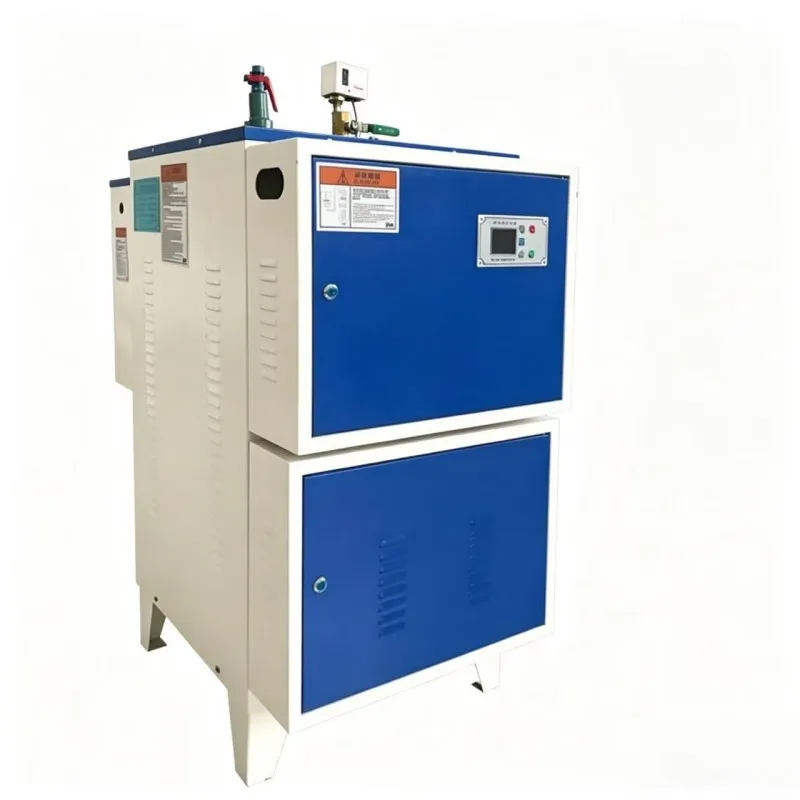
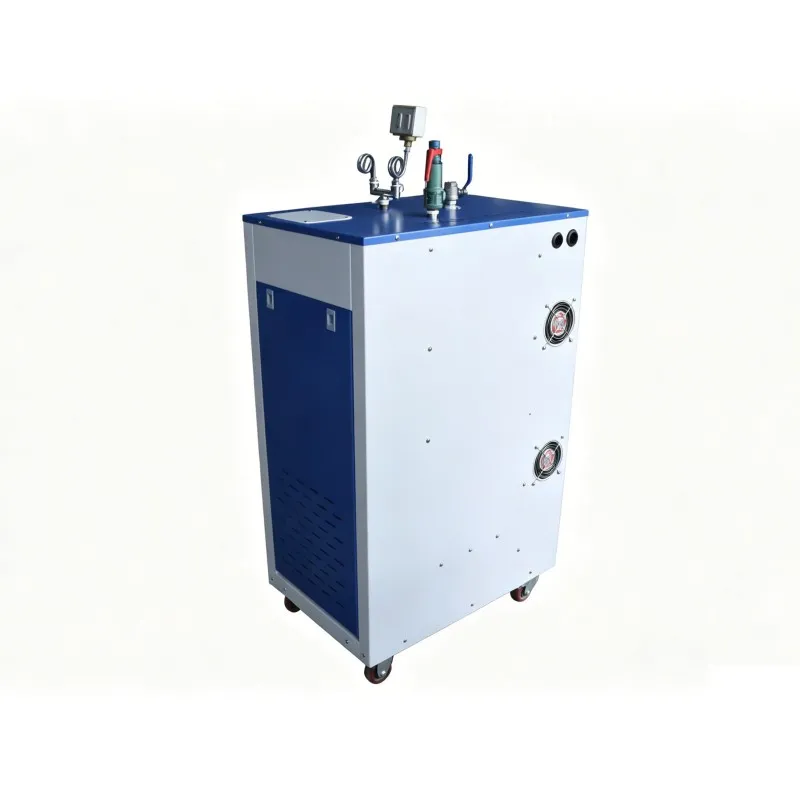
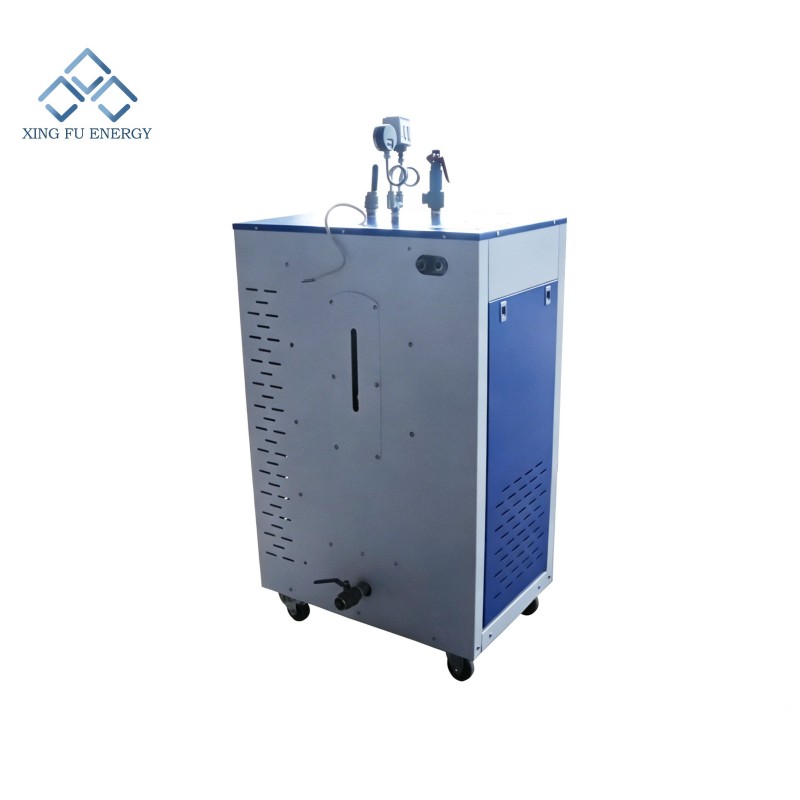
Footprint is the body plus the service face, and in a kitchen building the service face is usually designed last and regretted first. A 120 kg/h unit takes about 0.81 × 0.52 × 1.03 m, and the parts that need hands on them sit outside that box.
The water side needs room: a stainless water tank, a float level sensor and a copper feed pump, on a carbon steel shell with an optional stainless liner. Service access belongs on the pump and control face; drain and blowdown belong on the opposite side or below, so both sides need clearance.
Heating is electrical, so noise comes from the feed pump and pipe flow rather than combustion. Sound pressure at one metre and the building limit are project data, and ventilation, electrical clearance and separation from preparation areas follow local rules.
Lay out the room around the service faces, then place the unit; a body that fits with no service strip is installed but not serviceable. Measure to the wall, the nearest drain and the electrical entry, and keep the blowdown and safety valve operable from the front.
In practice, five mismatches account for most failed schemes, and each shows up as a symptom rather than as a quality complaint.
Check your scheme against these five before ordering; each has a cheap correction at the drawing stage and an expensive one after commissioning.
Sizing a steam boiler for central kitchen projects needs twelve inputs, and a supplier who quotes without them is quoting an average rather than your plant. The table below is the sheet to fill, one row per steam point.
| Input | Unit | Why it changes the answer |
|---|---|---|
| Steam point identifier | — | Keeps cooking, disinfection and utility loads separate |
| Peak demand at the point | kg/h | Sets capacity and the unit count |
| Continuous demand | kg/h | Sets the base load and cycling |
| Working pressure | MPa (state gauge) | Chooses the band and the terminal regulator |
| Temperature required at the point | °C | Confirms the band delivers the process temperature |
| Service window | clock times | Places the load on the fifteen-minute profile |
| Daily run hours | h/day | Distinguishes batch peaks from continuous supply |
| Supply voltage and frequency | V / Hz | Heater and electrical arrangement |
| Phase | single or three | Incoming supply and balance |
| Feedwater source and quality | analysis | Treatment requirement and blowdown |
| Redundancy | N+1 / staged / none | Continuity through the pre-service window |
| Destination country | — | Electrical standard and documentation |
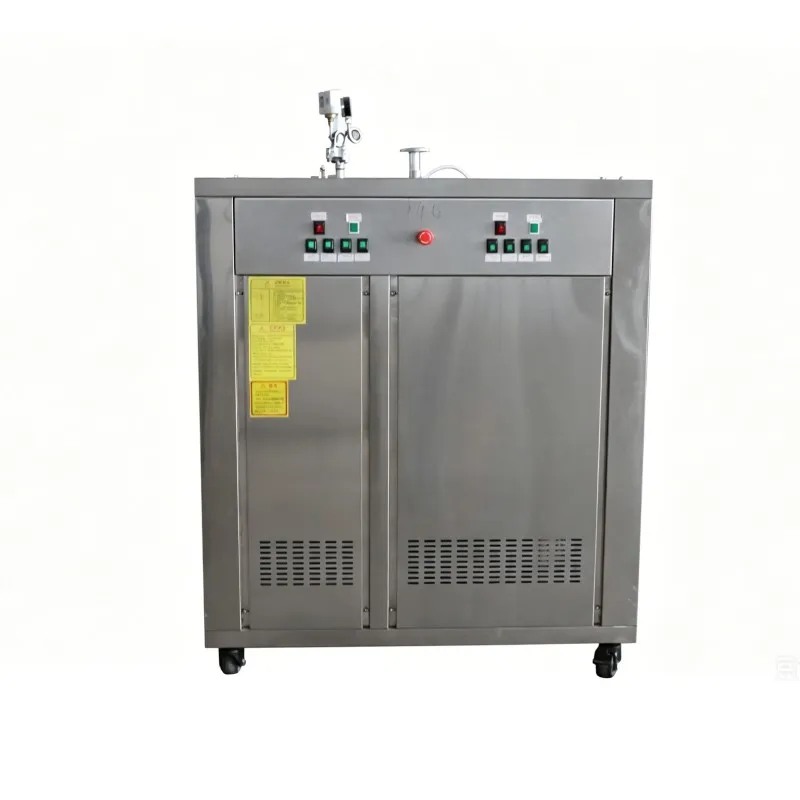
Rated supply options are 220/380/400/440 V at 50 or 60 Hz, single or three phase, and the destination country decides which applies. Pre-sales data normally asked for is steam demand, working pressure, voltage and frequency, phase, application and daily run hours, with the water source and destination country added.
Missing inputs fail predictably: a daily total with no peak gives an average-sized plant that cannot hold service temperature, and a pressure figure with no temperature leaves the regulator setting to guesswork.
Mark estimates as estimates, and send the sheet with the fifteen-minute profile that produced the peak.
Can one steam boiler for central kitchen duty cover three meal peaks?
Usually yes, if the peak fits the unit. Keep the highest fifteen-minute demand at or below 0.8 of the rating and one machine carries all three services; between 0.8 and 1.6 plan two units or stagger the batches that overlap. Above 1.6, re-sequence the menu before adding capacity.
How do I size steam capacity without a full menu analysis?
Use the heaviest service as the design case and take the peak from the devices running in it, then add 10–20% for draw variation and check the result against the rating. This shortcut is conservative on peak and silent on continuous load, so confirm washing and hot water demand separately.
Is 0.4 MPa enough for steam cabinets and jacketed kettles?
For cabinets, yes and more than enough: they cook near 100 °C and are regulated down to their inlet value. For jacketed kettles the ceiling at 0.4 MPa gauge is 151.8 °C, so a kettle that must hold 160 °C needs the upper part of the 0.4–0.7 MPa band.
How loud is an electric steam boiler in a kitchen building?
Heating is electrical, so noise comes from the feed pump and pipe flow rather than combustion. Measured sound pressure at one metre and the limit that applies in the building are project data, and both belong in the specification before the room is fixed.
Can the boiler sit next to the preparation area?
Only if separation, ventilation and electrical clearance are settled first. Local rules set those distances, and a unit against a shared wall passes pipe noise and heat into the preparation space. Confirm clearance and air-change requirements before drawing the layout.
What happens to steam supply if one unit fails?
With two units at 60% of peak each, one fault leaves a reduced but usable supply through the pre-service window. With a single unit carrying more than 80% of peak, the same fault is an outage, which is why the redundancy decision belongs in the specification rather than in the maintenance budget.
Send the fifteen-minute profile and the twelve-row sheet before asking for a price on a steam boiler for central kitchen work. Peak and simultaneity describe the plant; the sheet describes what has to be built.