-
+86-13791972057
-
No. 3009, Tower 3, Zhuoyue Century Center, No. 31th Longcheng Road, Qingdao, Shandong, China


+86-13791972057
No. 3009, Tower 3, Zhuoyue Century Center, No. 31th Longcheng Road, Qingdao, Shandong, China








2026-11-18
A brewery’s steam system rarely fails loudly. It fails quietly. The kettle takes four minutes longer to reach a rolling boil than it did last year, the CIP caustic reaches 78 °C instead of the 82 °C the SOP asks for, and the batch records show small deviations that nobody traces back to the boiler room. By the time throughput is increased, the unit is running flat out all day and each of those symptoms has been reclassified as normal for this plant.
This guide is organized around the way steam is actually consumed in a brewery rather than around equipment categories. It works through the brewhouse, the fermentation block and the cleaning station, sets out what each of them asks for in temperature, pressure and continuity, and then translates those demands into the five inputs any supplier needs before quoting. It also deals directly with a claim that appears in a great deal of supplier literature — that steam is used to control fermentation temperature — and explains what steam does there and what it does not.
If you are specifying a brewery steam solution, the useful question is not how large a unit you need, but what your load looks like hour by hour. Everything below builds toward that.
Steam earns its place in a brewhouse for one physical reason: it carries latent heat. A kilogram of saturated steam at atmospheric boiling point releases roughly 2,257 kJ as it condenses — less at higher pressure, where latent heat falls as temperature rises — and it does so at a constant temperature set by its pressure. In a steam-jacketed mash tun or wort kettle, that means the heat-transfer surface stays at a uniform temperature instead of developing hot spots the way a direct-fired surface can. For wort and mash, where local overheating causes scorching on the jacket, colour development and off-flavours, uniformity matters more than raw heating power.
The second consequence is control. Because saturated steam pressure and temperature are locked together, a brewer sets a process temperature by setting a pressure. Adjustment is handled by a regulating valve and a controller rather than by modulating a flame, and the response is fast.
The pressure–temperature relationship is worth keeping in mind for the rest of this article, because it explains why different processes need different steam conditions:
| Gauge pressure at the point of use | Saturated steam temperature (approx.) |
|---|---|
| 0.1 MPa | 120 °C |
| 0.3 MPa | 144 °C |
| 0.5 MPa | 159 °C |
| 0.7 MPa | 170 °C |
A brewery does not have one steam demand. It has five — hot liquor, mash heating, the kettle, CIP, and keg and packaging washing — and they behave in three different ways:
Sizing a system to the sum of these peaks, or to an annual average, produces either an oversized unit that cycles badly or an undersized one that loses pressure whenever two blocks coincide. The rest of this article works through each load, then shows how to turn them into a specification.
Every brew begins with hot water, and the hot liquor tank is usually the first significant load of the day. Hot liquor is generally held in the 70s to about 80 °C. Sparge water sits in that band to limit tannin extraction from the grain bed; strike water is drawn from the same tank and adjusted to whatever the first rest requires, normally a few degrees above the target mash temperature to allow for the heat the grist absorbs.
The character of this load is what matters: a large volume of water raised from ambient, or from a part-full tank, over a period long enough to be predictable. It is low-grade heat in the sense that the temperature is modest, but the volume is large and the draw usually has to be complete before the mash-in window opens.
Two practical points follow. First, this load rewards storage rather than instantaneous capacity. An insulated hot liquor tank heated during a quiet period and drawn down at mash-in decouples the steam system from the morning peak and lets a smaller unit serve the same brewery. Second, recovery time — how quickly the tank returns to setpoint after a draw — is often more valuable to production than a higher peak output, because it determines whether a second brew can start on schedule.
Hot liquor tank heating is also the load most easily improved in an existing plant: stratification in a tank with a poor inlet design can make the top of the tank read ready while the bottom is still cold, and the steam system gets blamed for a mixing problem.
Mash step heating is the opposite kind of load. The mash tun jacket or coil runs for a few minutes at each rest step, raising the mash by a defined increment, then holds. A temperature programme might involve two or three such steps, each a short, high-demand pulse separated by long holding periods.
Three engineering consequences follow:
Steam traps belong in this section because they are the most common cause of a jacket that shows full pressure while the mash refuses to heat. A failed trap floods the jacket with condensate, the heat-transfer coefficient collapses, and the controller responds by opening the valve further — which looks exactly like a capacity shortfall and is not one.
The wort kettle is the single largest steam consumer in a brewhouse, and the one load that genuinely cannot be interrupted. After lautering, the wort has to be brought from run-off temperature to a boil and then held at a rolling boil, typically for 60–90 minutes, with evaporation in the region of 5–8 % of volume per hour.
Boiling is not only a temperature duty; it is an evaporation duty. The heat input has to cover both the sensible heat needed to reach boiling and the latent heat of the water being evaporated, and it has to do so consistently for the whole boil. That is why kettle load is specified as a rate — kilograms of steam per hour held steady for the duration — rather than as a total energy figure.
Interruptions and pressure sag affect quality, not just schedule:
The kettle also sets the pressure requirement for most brewhouses, because it is usually the point that needs the highest steam temperature. Higher-pressure duties exist — steam sterilisation of kegs and casks, for example — but they are specified separately from the brewing loads. That pressure has to be available at the kettle inlet, not at the generator outlet, and the distinction is routinely lost between the specification and the installation.
Wort boiling steam demand is therefore specified twice: as a peak rate for sizing, and as a stability requirement for the duration of the block.
The cleaning station is the fourth major load inside the brewhouse, and the one most often left out of the sizing calculation because it does not run during production in the way the brewhouse does.
A CIP cycle heats detergent and rinse water to a set temperature, circulates it for a defined contact time, then repeats with the next chemistry. Caustic is typically run in the 70–85 °C band, with acid and sanitising stages at their own temperatures. Vessel washing, keg and cask washing, and packaging-day pasteurisation add further draws: keg washers take hot-water pulses through a shift, and a tunnel pasteuriser on a packaging day runs a long, moderate, steady load that can outlast the brewhouse entirely.
The point to hold onto is the shape of the load: half an hour of high demand, then nothing, several times a day — and frequently scheduled immediately after the boil, when the brewhouse is being cleaned and the next brew is being prepared. The coincidence of those two blocks is usually the real design case for a brewery.
Fermentation is an exothermic process. Yeast generates heat as it converts sugar, and in a cylindro-conical tank at production scale the heat release is substantial. To hold a fermentation at its set temperature, the tank has to be cooled — normally through a jacket or internal cooler carrying glycol, ice water or brine, with the chiller plant doing the work. Steam does not cool anything.
This matters because a fair amount of supplier material describes steam jackets for fermentation temperature control, and buyers then specify a steam system expecting it to manage fermentation. When the plant is commissioned, the steam side does its job and the fermentation still runs warm, because the cooling loop was never in scope.
Steam’s actual roles around fermentation are four:
The practical test for a buyer: if a supplier claims steam controls fermentation temperature, ask which medium circulates in the tank jacket, what produces the cold side, and whether the steam system is being sized for cleaning loads or for cooling. A small, flexible brewhouse may genuinely switch a jacket between hot water and coolant. A production brewery will not.
Cleaning effectiveness is governed by four variables — temperature, flow, time and chemical concentration — and steam controls only the first. But that first variable is not optional. Detergent below its working temperature cleans slowly and incompletely, and the temperature has to be reached within the cycle time, not at some point during it.
Two heating arrangements are used, and they are not interchangeable:
| Aspect | Indirect heating (heat exchanger or jacket) | Direct steam injection |
|---|---|---|
| Heating rate | Fast, limited by exchanger surface | Very fast; steam condenses into the liquid |
| Detergent concentration | Unchanged | Diluted by condensate and must be compensated |
| Control | Temperature loop on the exchanger | Pressure and flow control on the injection line |
| Hygiene considerations | Clean separation between steam and detergent, provided the exchanger is sound | Steam contacts the detergent directly, so steam quality and treatment chemicals matter |
| Typical fit | Larger CIP systems and multi-tank stations | Small plants, single-tank cleaning, rapid heat-up needs |
For a brewery, the indirect arrangement is the more common choice because it keeps detergent concentration stable and lets the same circuit run caustic, acid and rinse without re-dosing. Its one weakness is that separation depends on the exchanger: a leaking plate pack puts detergent into the steam side or steam into the detergent. Pressure testing belongs in the maintenance schedule for exactly this reason. Direct injection suits small installations where heat-up speed matters more than dosing precision.
CIP heating is also the load where insulation pays back fastest. A CIP tank or line that loses heat between cycles forces the heater to redo work it has already done, and that loss shows up as a longer heat-up time rather than as an obvious fault.
A CIP heat-up is a step change. The station returns cold or partly cooled detergent from the vessel, and the heater has to bring it back to setpoint within a defined window — often 30 to 60 minutes. That demand approaches the kettle’s during the ramp, and it very often coincides with the start of the next brew.
Four ways to deal with the overlap, in rough order of cost:
Three quantities decide whether a steam system fits a brewery: the pressure available at each point of use, the quality of the steam arriving there, and its ability to stay continuous through the longest block.
Pressure has to be specified at the point of use, then traced back. A kettle boiling at 100 °C needs a jacket temperature above 100 °C, which in practice means saturated steam above atmospheric pressure and a working temperature difference across the jacket surface. Add the pressure drop through the control valve, the distribution piping, the headers and any trap or strainer, and the generator outlet setpoint ends up meaningfully higher than the process figure. Systems specified the other way round — outlet pressure set equal to process pressure — are found short at commissioning, when the kettle ramps slowly and nobody can explain why.
Steam quality is a separate variable. Wet steam carries water droplets that add little heat and can erode valve seats; non-condensable gases accumulate in the jacket and blanket the heat-transfer surface. Both show up as the same symptom: the gauge reads correctly, the valve is open, and the vessel heats more slowly than the calculation predicted. Adequate separation, correct trapping and pipe insulation belong in the specification from the start rather than being treated as commissioning adjustments.
Continuity has three different meanings here. For the kettle it means no interruption for the duration of the boil. For CIP it means reaching setpoint inside the cycle window. For hot liquor it means recovering in time for the next brew. A system can satisfy one and fail another, which is why load shape — not total steam per day — determines the configuration.
Turndown is the quiet specification. A brewery’s demand swings between a small CIP top-up and a full kettle boil, several times a day. A single large unit that cannot modulate below a substantial fraction of its rating will short-cycle, which costs efficiency and element life. Staged heating elements, modular units, or a base-load unit combined with a peak unit all address this; the choice follows the load profile rather than a preference.
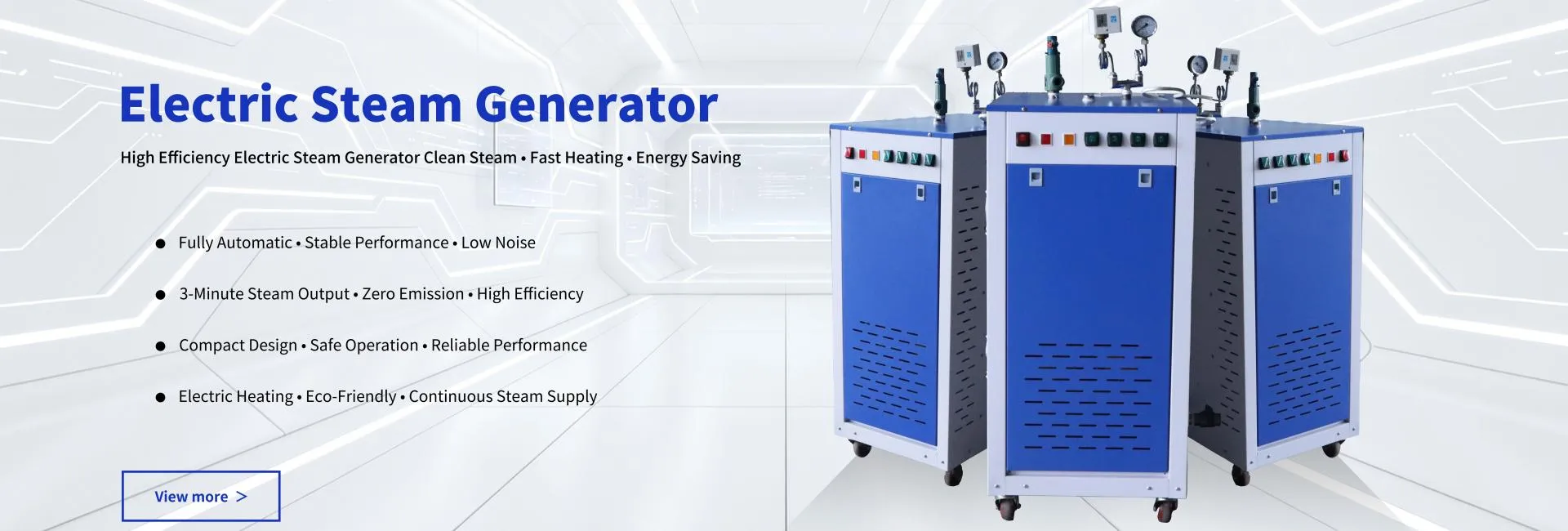
An electric steam generator for a brewery produces steam with no burner, no flue and no combustion air. That changes several things at once: no NOx or CO emissions at the point of use, no gas supply piping, no gas detection and interlock system, no chimney or stack, and no fuel storage.
The practical benefit is siting. A unit can be placed in the brewhouse or beside the CIP station, which shortens steam runs, reduces distribution losses and removes the need for a separate boiler house with its own ventilation and access requirements. For a brewery in an urban or mixed-use building, where a flue or a gas connection is simply not available, this is often the deciding factor rather than an efficiency argument.

The honest caveat: emissions move to the grid. A brewery reporting carbon per hectolitre should calculate the electric option using its local electricity carbon intensity, not assume zero. In markets with hydro, nuclear or a high renewable share the comparison is favourable; in coal-heavy grids it is not, and no amount of on-site cleanliness changes that.
Electric heating is inherently controllable. Power can be switched in stages or modulated continuously, so output follows demand without the thermal lag of a burner and a pressure vessel full of hot gas. Cold start to working pressure is typically short, which suits a brewery that starts and stops its steam demand several times a day.
The control set that matters in practice:
If a supplier cannot state which of these are standard and which are options, the specification is not yet complete.
This is also what makes a brewery steam solution manageable for a small team: breweries rarely staff a boiler room around the clock, and clear alarms with remote status are easier to leave unattended than a fuel-fired system — provided the protections are interlocked rather than advisory.
Without a burner, fan, flue or fuel train, the physical footprint and the civil works shrink. Noise is lower. Maintenance concentrates on a short list: heating elements, seals and gaskets, controllers and sensors, and the water treatment every steam system needs regardless of heat source. There is no combustion tuning, no flue gas analysis and no fuel-system inspection regime.

The word to avoid here is maintenance-free. Scale, corrosion and water quality affect electric units exactly as they affect fuel-fired ones — arguably more so for electrode-type units, which rely on water conductivity to pass current. A compact unit with neglected water treatment will fail on the same schedule as a large one.
Three constraints are real and should be priced in from the start.
Electrical capacity. Output and connected load are almost linear: producing a kilogram of steam from cold feedwater takes roughly 0.7 kWh of electrical input at typical efficiency. A brewery planning meaningful steam capacity is therefore planning a meaningful electrical connection, and the capacity available at the site — not the steam demand — often becomes the binding constraint. Transformer headroom, cable routing and switchgear belong in the early feasibility check.
Cost structure. Electric steam is cheapest where electricity is cheap relative to fuel, and most exposed where demand charges and peak tariffs are high. Whether it wins on operating cost depends on the electricity-to-gas price ratio in that market, the plant’s load factor, and how the site is billed for maximum demand. A blanket claim that electric steam is cheaper — or that it is always more expensive — is wrong in both directions.
Scale. For small and mid-sized brewhouses, a skid-mounted electric unit is compact and straightforward. For very large steam demand, the number of parallel modules, their footprint and the electrical infrastructure become a project in themselves, and a different heat source may be the more sensible engineering answer.

Where these constraints are acceptable — urban sites, indoor brewhouses, plants with existing electrical headroom, breweries with inexpensive renewable power, or sites where a flue and gas connection are impossible — an electric brewery steam solution removes a whole category of complexity from the building.
A quotation is only as good as the inputs behind it. Brewery steam system sizing starts with the load curve rather than the nameplate, and five inputs are needed.
A steam demand calculation is only as useful as the curve behind it: peak kilograms per hour, average over a production day, the duration of each block, and a diversity factor for loads that never run together. A brewery that can supply a 24-hour profile — even a hand-drawn one — gets a configuration. A brewery that supplies “about 500 kg/h” gets a guess.
List the requirement at the vessel, not at the generator: jacket temperature for the kettle, mash step temperatures, CIP setpoint, hot liquor target. Note which points are simultaneous, because simultaneity is what sets the peak.
Connected load in kW, voltage, phase, available capacity at the connection point, and whether the site has demand-charge exposure. This is where an electric project is won or lost, and it is usually a conversation with the electrical engineer rather than the steam supplier.
Shifts per day, brews per week, seasonal variation, planned maintenance windows. Whether the plant can tolerate a single unit down for a day determines whether N+1 is a requirement or a luxury.
Available floor space, access for element replacement, water quality and treatment, condensate return arrangements, ambient conditions and altitude.
A parameter sheet along these lines is enough to start an engineering review:
| Item | Unit | What to provide | Example (illustrative only) |
|---|---|---|---|
| Peak steam demand | kg/h | Highest simultaneous block | 600 |
| Average demand | kg/h | Per production day | 320 |
| Longest continuous block | min | Boil duration | 75 |
| Pressure at point of use | MPa (gauge) | Highest-pressure consumer | 0.4 |
| Connected electrical capacity available | kW | From the electrical study | 450 |
| Redundancy | — | N or N+1 | N+1 |
| Feedwater hardness | ppm as CaCO3 | Water analysis | 120 |
The example values are placeholders that show the format; they are not recommendations for any particular brewery.
Every steam system is a water system first. Hardness scales heating surfaces, chloride and dissolved oxygen corrode them, alkalinity drives carry-over, and conductivity determines whether an electrode-type generator can function at all. Feedwater treatment — softening, reverse osmosis or demineralisation, depending on the unit — plus blowdown control and periodic inspection are part of the system, not an accessory. Water limits must come from the specific unit’s documentation; there is no universal brewery figure.
Distribution design determines whether the pressure specified at the generator arrives at the kettle. Pipe sizing at sensible velocities, insulation on all hot lines, correct trap selection at every jacket and main, and a condensate return path back to the hot liquor tank or CIP preheat are the difference between a system that meets its numbers and one that is permanently a few degrees short.
Element replacement, controller access, electrical clearances and heat dissipation all need room. A unit installed tight against a wall will be shut down longer than necessary when maintenance is due, so confirm access requirements with the supplier before the plant room is laid out.

Pressure equipment regulation differs by market, and the applicable regime — design code, inspection requirement, operator qualification — should be established before the unit is ordered, not at commissioning. Electrical codes, lockout/tagout procedures and operator training complete the picture.
For a production brewery, steam availability is production availability. Worth confirming in writing: which spares are held locally (heating elements, seals, controllers, sensors), the service response commitment, remote diagnostic capability, and whether commissioning and operator training are included. These items rarely appear in a price comparison and frequently determine the cost of the first unplanned stop.
Can an electric steam system serve a brewhouse of my size?
It depends on the load profile, not on brewhouse volume alone. Two breweries of similar size can easily differ by a factor of two in peak demand, depending on batch size, heat-up time and whether CIP runs alongside the boil. What decides feasibility is the peak block in kg/h, the electrical capacity available, and whether the load can be buffered.
Is electric steam more expensive to run than fuel-fired steam?
It depends on three things: the electricity-to-fuel price ratio in your market, how you are billed for maximum demand, and the maintenance and compliance costs you avoid. In markets with low-cost hydro or nuclear power it frequently wins; with high demand charges and cheap gas it usually does not. Ask for a cost comparison built on your own tariff and load curve rather than a generic figure.
Do I need a separate steam source for CIP?
Usually not. CIP heating typically runs off the same system as the brewhouse, and the real question is whether it overlaps with the boil. If it does, buffering — hot water storage, an accumulator or staged modules — is cheaper than a second unit.
What steam pressure do I need for wort boiling?
Enough to deliver the required temperature at the kettle jacket after accounting for valve and line losses. Specify the jacket temperature, the run length and the pressure drop, and let the supplier calculate the outlet setpoint. Quoting a pressure without the piping context is guesswork on both sides.
Can steam be used to cool fermentation tanks?
No. Fermentation is exothermic and is cooled by a refrigerant circuit — glycol, ice water or brine. Steam’s role around fermentation is cleaning water, heating for specific process steps and, on some sites, driving an absorption chiller. A fermentation cooling problem will not be solved by the steam system.
What do you need from me to prepare a proposal?
The five inputs above: load profile, point-of-use pressure and temperature, electrical supply, operating pattern and redundancy, and site conditions. With those, an engineering review can begin. Without them, any capacity figure is an assumption.
If you are evaluating an electric option for your brewhouse, your load data will get you a useful answer far faster than a product enquiry. Send the 24-hour profile, the point-of-use conditions, your available electrical capacity, the operating pattern and site constraints, and request an engineering review of whether an electric brewery steam solution fits your plant, what configuration it implies, and what the electrical and water-side prerequisites are.
Product ranges and configurations for food and beverage processing are listed on our products page; selection and quotation questions are collected in the FAQ; and load data can be sent through the contact page.