-
+86-13791972057
-
No. 3009, Tower 3, Zhuoyue Century Center, No. 31th Longcheng Road, Qingdao, Shandong, China


+86-13791972057
No. 3009, Tower 3, Zhuoyue Century Center, No. 31th Longcheng Road, Qingdao, Shandong, China








2026-11-18
Walk into a bakery at four in the morning and the two things most likely to be wrong are invisible. The proofing room may be sitting at 68 % relative humidity instead of 82 %, and the oven’s steam valve may be opening for four seconds instead of twelve. Neither shows up on a display that anyone watches. Both show up ninety minutes later as flat loaves, a dull crust, or a batch that has to be sold as something other than what it was planned to be.
That is what makes bakery steam equipment unusual. In most process industries steam is a heating medium — it carries energy into a vessel and the job is done when the temperature arrives. In a bakery, steam is mostly a moisture medium. It humidifies a chamber so dough does not skin over, and it wets an oven’s atmosphere for the few seconds in which a loaf decides how much it will rise. Temperature matters, but humidity is the variable that decides quality, and humidity is the variable that is hardest to control well.
This guide covers the three duties — proofing, baking and the cleaning that follows them — plus the hygiene question that arises when steam meets product, and the parameters that have to be settled before a system is quoted.
Bakery steam equipment differs from the industrial steam described in plant-engineering guides in three ways.
The loads are small but demand precision. A proofing room or a rack oven draws a fraction of what a process vessel needs. What it demands instead is fine control: a humidity band held within a few percentage points, and a steam valve that opens and closes cleanly for seconds at a time.
The duty is intermittent and repeated. An oven may inject steam for a few seconds on every batch, all day. That is a valve cycling dozens of times per shift, which puts the emphasis on response time and on how the generator behaves when demand is mostly zero.

The steam can reach the product. Steam injected into an oven chamber surrounds the dough. Whatever is in the steam — treatment chemicals, carry-over, odour — is in the baking atmosphere. This is the point where a general-purpose steam system and a bakery-grade one diverge, and it is discussed in its own section below.
A proofing chamber holds dough at roughly 30–38 °C and 75–85 % relative humidity, with the exact band set by the product and by the bakery’s own experience rather than by a universal rule. The temperature is the easier half, and it usually arrives by a different route — a steam coil or a hot-water circuit heating the chamber air — which is why temperature and humidity are often two separate control loops rather than one. The humidity is the difficult half, because the chamber is warm, the dough is evaporating moisture into it, and every cool surface in the room drops below the dew point at some point during the day.
The purpose of that humidity is specific: it keeps the dough surface from drying. A surface that dries forms a skin, the skin restricts expansion during proof and in the oven, and the result is a loaf with reduced volume, a tight crumb and, in extreme cases, a tear along the side where the crust set before the interior finished expanding.
Three practical consequences follow from that purpose:
Direct steam injection admits steam into the chamber or into the air handler. It is fast, simple and gives immediate response, which suits proofers that are opened frequently. Its failure modes are overshoot and wet spots: injection close to a tray stack wets the product on one side, and a controller that reads a single humidity sensor in a stratified room will keep injecting after the average is satisfied.
Steam-to-air humidification passes steam through a distribution grid or manifold inside the air duct, so moisture enters as vapour carried by the air system rather than as a jet. It is slower to respond and needs a properly designed air path and a well-placed sensor, but it produces a more even room and less condensation on product.
Most bakeries end up with direct injection plus a circulating fan arrangement, and the quality of that arrangement decides whether the proofing room works. Where a proofer is retrofitted, the first question worth asking is where the steam enters relative to the air return, not how many kilograms per hour the generator can produce.
A proofing room is an incubator. It is warm, humid, and full of food. Condensate collects on ceilings, in tray rack crevices and on the cold surfaces of the chamber, and that condensate is a growth medium.
What this asks of the equipment is modest but specific:
None of this requires a specialised hygienic skid. It requires that the steam system be designed with the room in mind rather than bolted onto it afterwards.
When dough enters a hot oven, two processes compete: the interior expands as gases and water vapour warm, and the surface dries and sets into crust. If the surface sets first, expansion stops and the loaf stays small. Steam changes the order in which those two processes happen.
Steam condensing on the dough does two things at once. It transfers heat far faster than dry oven air can, which is why a steamed loaf begins expanding sooner and more evenly. And it keeps the surface wet. A wet surface cannot set into crust, because crust formation requires the surface to dehydrate first; while free water remains, evaporation holds the surface close to the boiling point of water, below the range at which a crust sets. The interior therefore keeps expanding — this is the mechanism behind oven spring.
The same moisture and heat gelatinise the surface starch. That gelatinised layer is what gives a crusty loaf its gloss and its thin, crisp finish rather than a dry, matte one. Once the steam is off, the surface water evaporates quickly, the temperature climbs, the crust sets, and colour develops through Maillard reactions and caramelisation.
That sequence — wet, expanding, then dry and colouring — is the whole of what oven steam contributes. It is also why timing matters more than quantity: steam that continues after the crust has set adds nothing to volume and starts to work against crust colour.
Deck ovens typically inject steam into the baking chamber at the start of the bake, through a valve or a steam inlet in the deck. The baker opens it manually or a steam timer does it, and on many decks the amount is still judged by the look of the chamber rather than by a sensor.
Rack and rotary ovens inject steam into the circulating air stream or directly into the chamber through a solenoid valve, often on a timed pulse at the start of the cycle followed by venting.
Tunnel ovens have a discrete steam zone at the entry, and the length of that zone relative to the bake time sets how much of the bake occurs under humid conditions. In a tunnel, the steam zone is a design parameter, not an operating one.
For all three, the useful question is the same: how long does the chamber actually stay humid after the valve closes? A large oven with a small vent holds moisture far longer than a small oven with a large extraction fan, and a programme copied from one to the other will produce different bread.
Too little. The crust sets before expansion finishes. Symptoms: low volume, a tight crumb, a crust that looks baked but the loaf is heavy. This is a common fault in bakeries that have recently changed ovens or cut steam time to save energy.
Too much. The crust stays wet too long, colour development is delayed, and the loaf comes out pale with a soft, flabby crust — and, in a tunnel, with a wet band where the steam zone ends.
Wet steam. Steam carrying water droplets rather than dry vapour deposits water unevenly, producing patches, marks on the crust and inconsistent colour across the tray. It also loads the oven with water that has to be evaporated, which slows the bake.
Chemical carry-over. Steam from a system using treatment chemicals not intended for food contact can introduce odours into the baking chamber. This is subtle and often attributed to flour or fermentation when it is in fact the steam.
Oven steam surrounds the dough; proofing steam condenses on chamber surfaces near product; direct-injection systems put steam into the same air the product breathes. Whether or not steam technically touches the product, the practical requirement is the same: it has to be clean enough that nobody can taste or smell it.

The provisions that belong in a bakery specification:
No article can certify a plant’s compliance on the plant’s behalf, and none should try. What can be stated precisely is this: these are the provisions that define food-contact steam, and the plant’s own hygiene audit is where they are verified.
Bakery steam demand rarely comes from one place. It comes from a proofer that draws continuously at low rate, a set of ovens that each draw a short pulse at the start of every bake, and a cleaning load that arrives at the end of the shift. A capacity figure based on the sum of nameplate pulses will be far larger than the plant needs; a figure based on the proofer alone will starve the ovens.
The practical approach is to build the load from three numbers: the proofer’s continuous demand, the largest simultaneous oven pulse, and the sanitation draw — then check whether the proofer can tolerate a brief pressure dip while the ovens fire. In most bakeries it can, because the proofer’s humidity responds slowly. That single observation often removes the need for a larger generator.
The third duty is easy to leave out of the calculation and hard to leave out of the schedule. Proofing chambers, oven decks, conveyor bands and tray racks are cleaned at the end of the shift, and the hot water for that cleaning is usually the reason a bakery needs more capacity than its ovens alone suggest.
Two distinctions are worth keeping straight. Cleaning water is a hot-water duty rather than a steam duty, and it is normally served from the same generator through a heat exchanger or from a separate hot-water set. Where steam itself is used on surfaces, it should come from the same food-contact side as the oven steam, because those surfaces are what the product touches next.
For sizing, sanitation is a block load that arrives when nothing else is running. It is therefore a weak argument for a larger generator and a strong argument for a hot-water buffer — which is the cheapest way most bakeries absorb it.
Bakery steam systems are small, and small systems are where distribution errors dominate. Points worth insisting on:
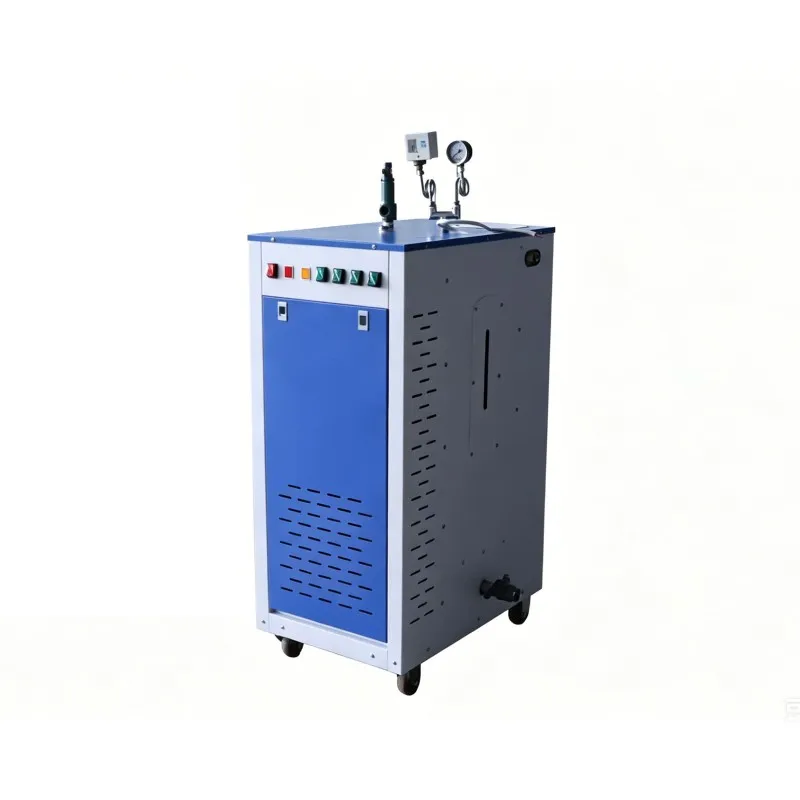
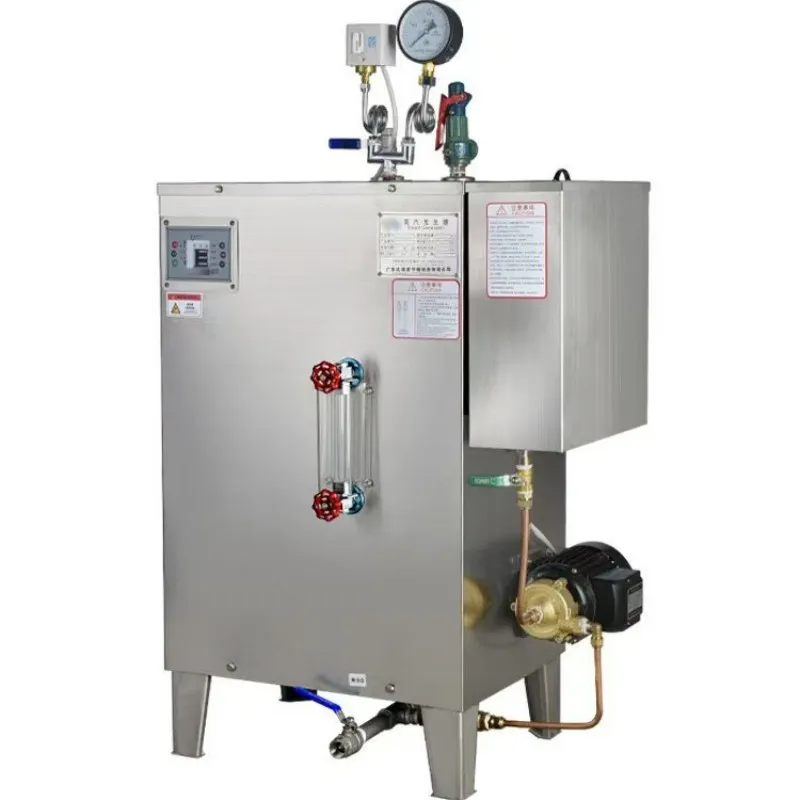
An electric generator can sit close to the ovens, which matters in a bakery because the long run from a distant plant room is usually the reason oven steam arrives wet. Placement also has to respect the room: bakery production areas are washed down, flour dust is everywhere, and a unit tucked against a wall with no service access will be neglected.

Controls should be specified to match how the bakery actually runs:
Bakery steam equipment is quoted most reliably against the oven and proofer schedule rather than against a single capacity figure.
| Item | Unit | What to provide | Example (illustrative only) |
|---|---|---|---|
| Proofer continuous demand | kg/h | At held humidity, per room | 40 |
| Oven pulse demand | kg/h | Per oven, at valve opening | 120 |
| Simultaneous ovens | number | Worst-case overlap | 2 |
| Injection duration | s | Per bake, per oven type | 10 |
| Pressure at point of use | bar (gauge) | At the oven inlet | 1.0 |
| Steam quality class | — | Food-contact or indirect | food-contact |
| Sanitation hot water | L/h at °C | End-of-shift cleaning | 800 at 60 |
| Electrical supply | V / phase / Hz | From the electrical study | 415 / 3 / 50 |
| Hours of operation | h/day | Including sanitation | 16 |
| Feedwater hardness | ppm as CaCO3 | Water analysis | 80 |
The values show the format rather than a recommendation.
Two additional questions belong in the same conversation, because they are usually what decides whether the system works: how the oven chamber is vented, and how the proofer’s air is distributed. A supplier who asks those two questions is sizing the installation; one who does not is sizing a box.
A bakery steam boiler or generator is usually the smallest item in the plant room and the one most often left to look after itself, which is why most of the faults that stop production start as small ones nobody logged.
The system fails in boring ways, and the routine that prevents it is short:
Bakery generators are small, and a small generator scales quickly relative to its output because the water it holds is turned over fast. Hardness deposits on the heating elements, reduce output, and eventually cause element failure at the least convenient hour. Softening or reverse osmosis for make-up water, conductivity-based blowdown and periodic descaling belong in the plan from the start — not as a response to the first failure.
Water quality has a second face in a bakery: scale and carry-over put solids into steam that may reach food. A system that is mechanically fine but producing steam with dissolved solids is a quality risk even when nothing has broken.

Where steam is injected into an oven, dryness and non-condensable gas content are worth checking at commissioning and then periodically. Wet steam shows up as uneven colour across a tray; non-condensables show up as an oven that is slow to come to condition and heats unevenly. Neither is visible on a pressure gauge.
Records matter for a different reason: when a batch is questioned, the ability to show what the steam system was doing during that bake is the difference between a resolvable complaint and a discount.
The steam generator for a bakery is sized from the proofer’s continuous draw and the largest simultaneous oven pulse, not from the number of ovens. A bakery with four ovens that never fire together may need less capacity than one with two that do.
Usually yes, provided the proofer can tolerate a short pressure dip when the ovens inject. That is a question about the proofer’s control behaviour, and it is worth testing rather than assuming.
Pale crust with good volume usually points to too much steam or steam that stays on too long, because colour develops only after the surface dries. The other possibility is that the steam is wet and the chamber never fully clears.
It can, if the steam carries treatment chemicals or odours. Steam that may reach product should be produced from potable water with additives acceptable for food-contact use, and it should be checked at commissioning.
Commonly in the 75–85 % range, but the right figure is the one that keeps the dough surface from drying without condensing on product. It is a plant-specific setting, not a universal standard.
It generally is, because bakery loads are modest and the requirement is precise, repeatable injection rather than bulk heat. The constraints are electrical capacity and water treatment, not the principle.
If you are specifying bakery steam equipment, the two documents that move a project forward fastest are the oven schedule and the proofer’s humidity requirement — not a capacity figure. Send the pulse duration per oven, the number of ovens that fire together, the proofer’s continuous demand and its humidity band, the pressure required at the oven inlet, whether steam may contact product, and the available electrical supply. With those, an engineering review can establish the configuration, the steam-quality provisions and the water-side prerequisites.